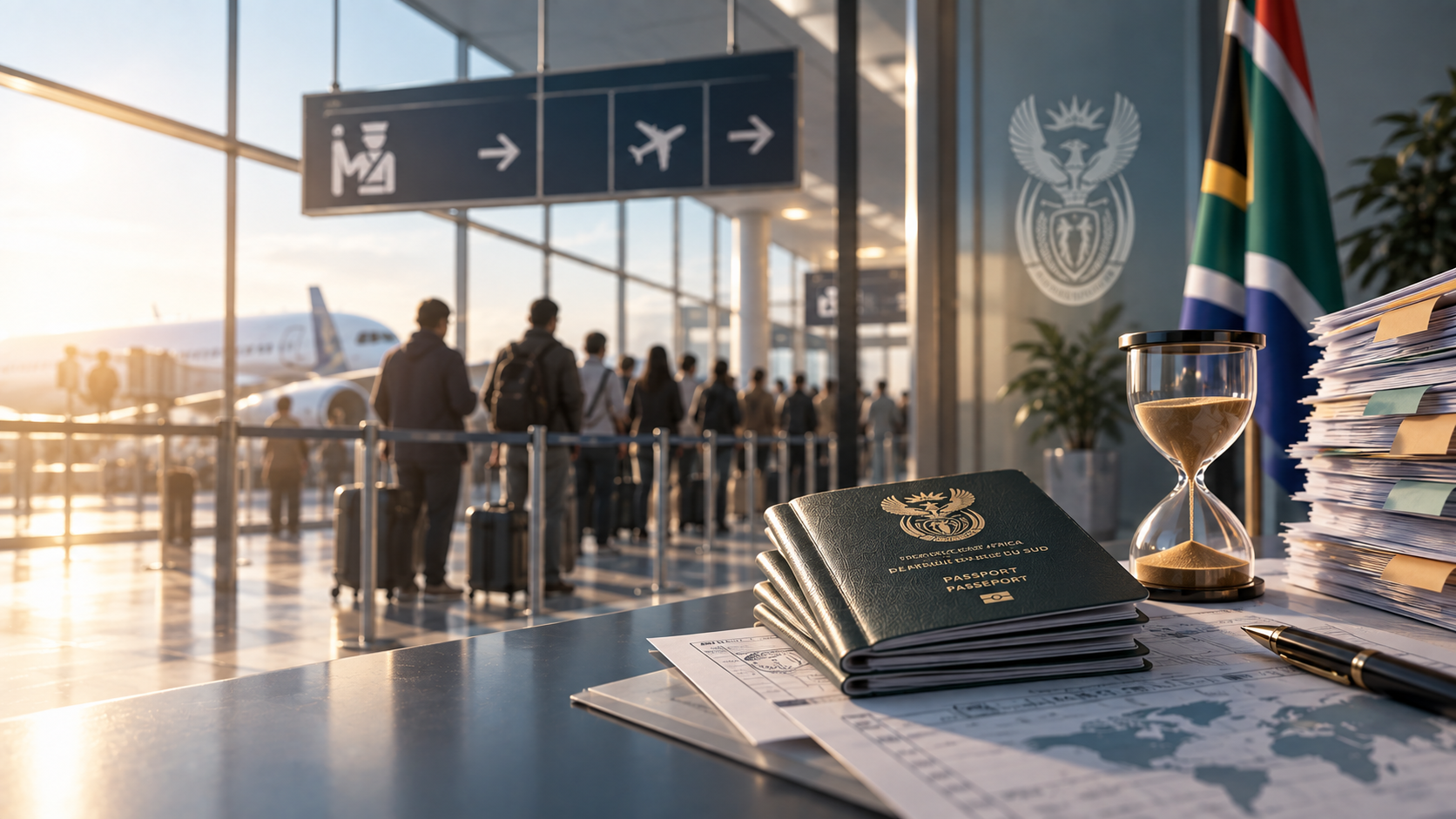
sourced from

The South African Revenue Service (SARS) is grudgingly acknowledged as one state institution that acts with unfailing efficiency – at least when it comes to extracting taxes.
It is a slender list, for sure, but perhaps Home Affairs may now warrant an honourable mention as it rolls out new digital services by the week. Queues have shortened, and turnaround times for some services have fallen from weeks to just minutes.
The limitations imposed by its roughly 350 offices around the country have been eased by the addition of more than 320 bank branches equipped to capture biometric data and submit applications for processing.
Over the past four months, these branches have processed more than 422 000 applications, most of them for smart IDs.
That’s a 400% increase on previous volumes, achieved without any increase in the department’s budget or staff complement.
Home Affairs plans to expand the network to 750 bank branches by the end of 2026 and progressively add services, including first-time smart ID applications and passport applications and renewals.
Digital overhaul
The department’s flagship reform is the Electronic Travel Authorisation (ETA), launched by Home Affairs Minister Leon Schreiber in September 2025 ahead of South Africa’s G20 summit. It was initially limited to visitors from China, India, Indonesia and Mexico.
Unlike the previous eVisa system, the ETA automates the entire application and adjudication process rather than simply digitising applications. One of its aims is to reduce the opportunities for human intervention – and bribery.
Since its launch, it has processed more than 203 000 foreign visitor applications and intercepted more than 5 000 fraudulent applications and manipulated documents.
“No immigration official could process that volume,” Schreiber told the Xpatweb Global Mobility Conference in Bryanston this week.
“We’re not tinkering at the edges of a catastrophically broken system. By the end of this year, we plan to expand the ETA beyond tourists into additional visa categories, beginning with categories such as study visas.”
Home Affairs appears to have learned a few lessons from SARS and its use of automated tax-assessment systems, which Schreiber has cited as a model for processing large volumes without increasing staff numbers.
The ETA is linked to an upgraded electronic movement control system that uses facial recognition at ports of entry. Home Affairs now intends to extend it to more visa-required nationalities, visa categories and ports of entry.
As more Home Affairs services move online and become accessible by mobile phone, officials stationed at South African missions abroad can be recalled or redeployed. This could save the department about R200 million a year, according to Yusuf Simons, acting deputy director-general for immigration services.
Visa reform
Another key reform was the introduction of the Trusted Employer Scheme (TES), which gives pre-vetted companies a faster and less onerous route for bringing skilled foreign employees into SA.
Launched in 2024 with about 70 large companies on the initial pilot, it processed about 83% of applications against the critical skills list within four weeks.
This fell short of its 95% target, but was considerably faster than the delays previously experienced by many employers.
Schreiber this week announced the second phase of the scheme, which is open to a wider range of companies, including businesses involved in strategic infrastructure projects, financial-sector companies, and those establishing regional or global headquarters in SA.
Expressions of interest close on 4 September.
Backlog battle
One of Home Affairs’s early successes was the near-elimination of a backlog of more than 300 000 visa and permit applications. However, the clearing operation of the backlog led to a sharp increase in appeals against rejected applications.
Simons says the backlog is monitored daily. Although it subsequently began to grow again, it was reduced from 54 000 to 44 000 cases within a month.
The department is also digitising refugee appeals, with more than 120 000 cases currently under consideration.
Home Affairs has joined forces with the Gauteng and Cape Bars, with support from the United Nations High Commissioner for Refugees, in a programme that has reduced the appeals backlog by more than 12%.
Anti-corruption drive
Home Affairs is also claiming progress against corruption.
Across Home Affairs and the Border Management Authority, 98 officials have been dismissed since the start of the GNU (government of national unity) administration, while 40 people have been arrested and 10 convicted for corruption and maladministration.
A Special Investigating Unit investigation found that corrupt officials exploited manual, paper-based processes, weak verification, poorly integrated systems, and inadequate controls.
These weaknesses allowed officials to overlook fraudulent documents, bypass procedures and improperly approve applications.
“Discretion is the root of the problem,” said Schreiber.
The findings have reinforced the department’s drive to digitise and decentralise its services. By automating decisions, Home Affairs aims to create an electronic audit trail while removing officials’ ability to approve applications selectively.
The road ahead
Home Affairs is not yet a model department. It continues to experience system downtime, staffing and infrastructure shortages, and substantial backlogs in certain areas.
It also received a qualified audit opinion for 2024/25, while the Auditor-General questioned the reliability of some of its reported performance information.
But the direction of travel is difficult to dispute. Schreiber’s ambition is to turn Home Affairs into a model of public-sector excellence – not only in South Africa but internationally.